The oil and gas industry plays an important role in the global energy sector, creating career opportunities in exploration, drilling, production, refining, pipeline operations, maintenance, and industrial inspection. For students and job seekers interested in technical careers, oil and gas engineering offers several pathways into a specialised and challenging industry.
With projects involving refineries, offshore platforms, petrochemical plants, pipelines, and energy infrastructure, skilled technical professionals are needed across different stages of oil and gas operations.
If you are planning to build a career in this field, understanding the available job roles, essential skills, qualifications, and salary factors can help you choose the right training pathway.
In this guide, we explore oil and gas engineering careers, popular specialisations, job opportunities in India and the Gulf, and how technical training can support your career goals.
What Is Oil and Gas Engineering?
Oil and gas engineering involves the technical activities required to explore, extract, process, transport, and maintain systems associated with petroleum and natural gas.
Professionals in this sector work across upstream, midstream, and downstream operations.
- Upstream: Exploration, drilling, and production of crude oil and natural gas.
- Midstream: Transportation, storage, and distribution of oil and gas through pipelines and related infrastructure.
- Downstream: Refining, processing, petrochemicals, and distribution of petroleum products.
The industry includes engineers, technicians, inspectors, safety professionals, maintenance specialists, and quality control personnel. The qualifications required depend on the specific role.
Top Oil and Gas Engineering Job Roles
There are several career options for candidates interested in oil and gas engineering. Your suitable role will depend on your educational background, technical knowledge, experience, and chosen specialisation.
1. Oil and Gas Engineer
Oil and gas engineers support the design, operation, maintenance, and improvement of systems used in petroleum production and processing.
Typical responsibilities include analysing operational requirements, monitoring equipment performance, supporting engineering projects, and improving operational efficiency.
Relevant engineering disciplines may include mechanical, chemical, petroleum, electrical, and instrumentation engineering.
2. QA/QC Engineer
Quality Assurance and Quality Control (QA/QC) professionals help ensure that materials, equipment, fabrication, welding, and construction activities meet project specifications and applicable standards.
Common responsibilities include:
- Reviewing quality documentation
- Monitoring fabrication and inspection activities
- Checking compliance with technical specifications
- Coordinating inspections and testing
- Preparing quality reports and records
QA/QC careers may be suitable for candidates with relevant engineering or technical qualifications and appropriate industry training.
3. NDT Technician or Inspector
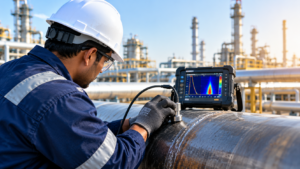
Non-Destructive Testing (NDT) professionals inspect materials and components without causing damage to them.
Common NDT methods include:
- Ultrasonic Testing (UT)
- Radiographic Testing (RT)
- Magnetic Particle Testing (MT)
- Liquid Penetrant Testing (PT)
- Visual Testing (VT)
These techniques are used to inspect welds, pipelines, pressure vessels, storage tanks, and industrial components.
Candidates must meet the training, experience, examination, and certification requirements applicable to their selected NDT method and certification scheme.
4. HSE Officer
Health, Safety and Environment (HSE) professionals help maintain safe working conditions at industrial facilities and project sites.
Their responsibilities may include conducting safety inspections, identifying hazards, supporting risk assessments, monitoring compliance, and promoting safe working practices.
Relevant safety qualifications, industry knowledge, and practical experience can be important for employment.
5. Piping Engineer
Piping engineers work with piping systems used to transport fluids and gases in refineries, petrochemical plants, and other industrial facilities.
Typical activities include piping design, layout coordination, material selection, specification reviews, and coordination with other engineering disciplines.
The role generally requires relevant engineering knowledge and proficiency with applicable design tools and standards.
6. Welding Inspector
Welding inspectors check welding activities and completed welds against approved procedures, project specifications, and applicable acceptance criteria.
Their work may involve reviewing welding documentation, monitoring welding parameters, coordinating NDT activities, and preparing inspection reports.
Candidates may need relevant technical experience and recognised welding inspection qualifications, depending on the position.
7. Refinery Operations Technician
Refinery operations technicians support the operation and monitoring of processing units and associated equipment.
Responsibilities can include monitoring process conditions, following operating procedures, identifying abnormal conditions, and coordinating with control-room and maintenance teams.
Process knowledge, equipment familiarity, and safety awareness are important for this career pathway.
8. Mechanical Maintenance Technician
Mechanical maintenance technicians help maintain pumps, compressors, valves, rotating equipment, and other machinery used in industrial facilities.
Their work may include preventive maintenance, troubleshooting, equipment checks, repairs, and maintenance documentation.
Relevant mechanical training, practical skills, and equipment-specific experience can improve employability.
Essential Skills for an Oil and Gas Career
Technical knowledge alone may not be sufficient for a successful career. Employers often look for candidates who can work safely, follow procedures, and communicate effectively.
Technical Skills
- Understanding of industrial equipment and engineering drawings
- Knowledge of welding and fabrication processes
- Familiarity with inspection and testing methods
- Basic understanding of piping systems and materials
- Knowledge of quality control procedures
- Awareness of industrial safety requirements
The exact skills required vary by job role.
Safety Awareness
Oil and gas facilities can involve hazardous materials, high pressure, high temperatures, heavy machinery, and confined spaces. Understanding permit-to-work systems, personal protective equipment, hazard identification, and emergency procedures is essential.
Communication and Documentation
Professionals may need to prepare inspection reports, record maintenance activities, communicate technical findings, and coordinate with engineers, supervisors, and project teams.
Problem-Solving Skills
The ability to identify technical issues, follow troubleshooting procedures, analyse inspection findings, and report problems accurately is valuable across the industry.
Qualifications Required for Oil and Gas Jobs
The educational requirements depend on the position.
Engineering roles: Many engineering positions require a relevant bachelor’s degree or other specified engineering qualification.
Technician roles: Some positions accept relevant diplomas, vocational qualifications, or technical training combined with practical experience.
Inspection roles: NDT, welding inspection, and QA/QC positions may require specialised training, recognised certifications, documented experience, or a combination of these.
Safety roles: HSE positions may require relevant safety qualifications and experience, depending on the employer and project.
Before enrolling in a course, check the eligibility criteria and qualifications requested in actual job advertisements. A short-term course may support technical skill development, but it does not replace a mandatory engineering degree or professional certification where one is required.
Oil and Gas Engineering Career Scope in India
India has employment opportunities across refineries, petrochemical facilities, manufacturing plants, offshore operations, pipeline projects, engineering contractors, and inspection companies.
Potential employers include oil and gas operators, fabrication companies, engineering and construction contractors, equipment manufacturers, maintenance service providers, and third-party inspection agencies.
Career opportunities may be available in areas such as:
- Oil refinery operations
- QA/QC and industrial inspection
- NDT testing
- Welding and fabrication inspection
- Piping and mechanical maintenance
- HSE and industrial safety
- Pipeline construction and maintenance
Recruitment depends on project activity, experience requirements, employer needs, and the candidate’s qualifications.
Oil and Gas Jobs in Gulf Countries
The UAE, Saudi Arabia, Qatar, and Oman have oil and gas operations, refineries, petrochemical facilities, pipeline networks, and industrial construction projects.
Candidates may explore opportunities such as NDT technician, QA/QC inspector, welding inspector, mechanical technician, piping-related roles, and HSE positions where they meet the employer’s requirements.
To improve your readiness for Gulf employment:
- Choose a job role that matches your educational background.
- Obtain relevant technical training and certifications.
- Develop practical skills and seek suitable industry experience.
- Prepare a clear CV highlighting qualifications, methods, equipment, and project experience.
- Check the certification, experience, safety, and work authorisation requirements in each job advertisement.
A training certificate does not guarantee overseas employment. Employers may require several years of experience, project-specific credentials, or additional approvals.
Oil and Gas Engineering Salary in India and the Gulf
Oil and gas salaries vary considerably according to job title, qualifications, location, employer, project conditions, and years of experience. There is no single salary applicable to every oil and gas professional.
The following factors influence earning potential:
- Job role: Engineering, inspection, maintenance, operations, and safety positions have different requirements and pay structures.
- Experience: Experienced professionals may qualify for more specialised or senior responsibilities.
- Certifications: Relevant, recognised credentials can support eligibility for certain technical positions.
- Industry specialisation: Offshore operations, complex inspection work, and specialised industrial projects may have different compensation structures.
- Location and contract: Salaries and benefits vary between India and Gulf countries, as well as between permanent and project-based employment.
When comparing opportunities, consider the complete compensation package, including accommodation, transport, insurance, overtime, leave, and other contractual benefits where applicable.
For realistic salary expectations, review recent job advertisements for your exact role and experience level rather than relying on a single industry-wide figure.
How to Start a Career in Oil and Gas Engineering
If you want to enter the oil and gas sector, follow a structured approach.
Step 1: Identify Your Career Goal
Decide whether you are interested in engineering, inspection, safety, operations, maintenance, or quality control.
Step 2: Check Your Eligibility
Compare your education and experience with the requirements of your preferred job roles.
Step 3: Choose Relevant Technical Training
Depending on your career goal, consider training in QA/QC, NDT, piping, welding inspection, HSE, or refinery operations.
Step 4: Build Practical Knowledge
Learn to interpret technical drawings, understand inspection procedures, use relevant equipment, and prepare technical documentation.
Step 5: Obtain Required Certifications
Identify the qualifications and certification schemes recognised by your target employers. Confirm whether industrial experience or formal examinations are required.
Step 6: Apply for Suitable Positions
Search for entry-level or experienced positions that match your qualifications. Prepare a CV that clearly presents your technical skills, training, experience, and certifications.
Why Choose Technical Training for an Oil and Gas Career?
Specialised training can help candidates understand industry practices and develop skills relevant to selected technical roles.
For example, QA/QC training may introduce quality documentation and inspection processes, while NDT training focuses on testing methods and defect detection. HSE training focuses on hazard awareness and safe working practices.
When choosing a training institute, compare the course syllabus, practical facilities, trainer experience, certification arrangements, and career support. Make sure the programme matches the requirements of the jobs you intend to pursue.
Candidates exploring oil and gas and inspection-related training can review the relevant programmes offered by IMS Cochin and confirm the latest course details and eligibility requirements directly with the institute.
Conclusion
An oil and gas engineering career offers multiple pathways across engineering, inspection, quality control, safety, operations, and maintenance. The right career choice depends on your educational background, technical interests, and long-term goals.
Building relevant technical skills, gaining practical experience, meeting certification requirements, and applying for suitable positions can help you prepare for opportunities in India and the Gulf.
Start by identifying your preferred job role, checking employer requirements, and choosing training that supports your intended career pathway.
Frequently Asked Questions
1. What are the best jobs in oil and gas engineering?
Popular career options include oil and gas engineer, QA/QC engineer, NDT technician, welding inspector, piping engineer, HSE officer, refinery operations technician, and mechanical maintenance technician.
2. What qualifications are needed for oil and gas jobs?
Requirements vary by position. Engineering roles may require a relevant engineering degree, while certain technical roles accept diplomas or vocational qualifications alongside relevant training and experience.
3. Is oil and gas engineering a good career choice?
It can be a suitable career for candidates interested in technical work, industrial operations, inspection, and energy infrastructure. Career prospects depend on industry demand, qualifications, experience, and specialisation.
4. Which oil and gas courses are useful for technical jobs?
Depending on your background and target role, relevant options may include QA/QC, NDT, piping, welding inspection, HSE, and refinery operations training.
5. Are oil and gas jobs available in Gulf countries?
Opportunities arise in countries such as the UAE, Saudi Arabia, Qatar, and Oman. Eligibility depends on the employer, job role, qualifications, experience, certification, and work authorisation.
6. Can freshers get oil and gas jobs?
Some entry-level positions and trainee opportunities may be available to freshers. Other roles require practical experience, professional qualifications, or recognised certifications.
7. What is the salary of an oil and gas engineer?
Salary depends on the engineering discipline, location, experience, employer, and project. Candidates should compare current vacancies for their specific role and qualification level.
8. What is the difference between QA/QC and NDT?
QA/QC covers broader quality planning, verification, documentation, and compliance activities. NDT focuses on specific testing methods used to examine materials and components without damaging them.
9. Is NDT useful for an oil and gas career?
Yes. NDT methods are used to inspect welds, pipelines, pressure vessels, and other industrial components. Relevant qualifications, practical experience, and certification may be required for particular roles.
10. How can I choose the right oil and gas training institute?
Check the course syllabus, trainer expertise, practical training facilities, certification scheme, eligibility criteria, and career support. Confirm all claims about certification and placement before enrolling.